 |
Peano
|
|
Peano
|
CCZ4 solver using Runge-Kutta Discontinuous Galerkin and global adaptive time stepping incl enclave tasking. More...


Public Member Functions | |
| __init__ (self, name, rk_order, polynomials, min_cell_h, max_cell_h, pde_terms_without_state) | |
| Construct solver with enclave tasking. | |
| add_tracer (self, name, coordinates, project, number_of_entries_between_two_db_flushes, data_delta_between_two_snapsots, time_delta_between_two_snapsots, clear_database_after_flush, tracer_unknowns) | |
| Add tracer to project. | |
 Public Member Functions inherited from CCZ4Solver.AbstractCCZ4Solver Public Member Functions inherited from CCZ4Solver.AbstractCCZ4Solver | |
| enable_second_order (self) | |
| add_all_solver_constants (self) | |
| Add domain-specific constants. | |
| add_makefile_parameters (self, peano4_project, path_of_ccz4_application) | |
| Add include path and minimal required cpp files to makefile. | |
Additional Inherited Members | |
| Data Fields inherited from CCZ4Solver.AbstractCCZ4Solver | |
| integer_constants | |
| double_constants | |
| Default_Time_Step_Size_Relaxation | |
| Static Public Attributes inherited from CCZ4Solver.AbstractCCZ4Solver | |
| float | Default_Time_Step_Size_Relaxation = 0.1 |
| Protected Member Functions inherited from CCZ4Solver.AbstractCCZ4Solver | |
| _add_standard_includes (self) | |
| Add the headers for the compute kernels and initial condition implementations. | |
| Static Protected Attributes inherited from CCZ4Solver.AbstractCCZ4Solver | |
| dict | _FO_formulation_unknowns |
| dict | _SO_formulation_unknowns |
CCZ4 solver using Runge-Kutta Discontinuous Galerkin and global adaptive time stepping incl enclave tasking.
The constructor of this classs is straightforward and realises the standard steps of any numerical implementation of the CCZ4 scheme:
Definition at line 1455 of file CCZ4Solver.py.
| CCZ4Solver.CCZ4Solver_RKDG_GlobalAdaptiveTimeStep.__init__ | ( | self, | |
| name, | |||
| rk_order, | |||
| polynomials, | |||
| min_cell_h, | |||
| max_cell_h, | |||
| pde_terms_without_state ) |
Construct solver with enclave tasking.
Reimplemented from CCZ4Solver.AbstractCCZ4Solver.
Definition at line 1483 of file CCZ4Solver.py.
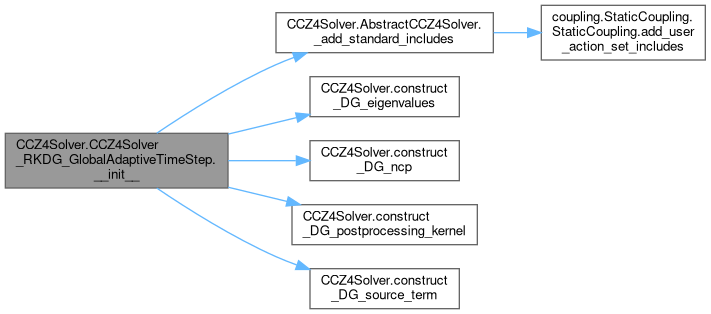
References CCZ4Solver.AbstractCCZ4Solver._add_standard_includes(), CCZ4Solver.AbstractCCZ4Solver._FO_formulation_unknowns, CCZ4Solver.construct_DG_eigenvalues(), CCZ4Solver.construct_DG_ncp(), CCZ4Solver.construct_DG_postprocessing_kernel(), and CCZ4Solver.construct_DG_source_term().
| CCZ4Solver.CCZ4Solver_RKDG_GlobalAdaptiveTimeStep.add_tracer | ( | self, | |
| name, | |||
| coordinates, | |||
| project, | |||
| number_of_entries_between_two_db_flushes, | |||
| data_delta_between_two_snapsots, | |||
| time_delta_between_two_snapsots, | |||
| clear_database_after_flush, | |||
| tracer_unknowns ) |
Add tracer to project.
Consult exahype2.tracer.DumpTracerIntoDatabase for an explanation of some of the arguments. Most of them are simply piped through to this class.
At this point, we have not yet created the Peano 4 project. Therefore, we have not yet befilled the time stepping action set.
project: exahype2.Project
Reimplemented from CCZ4Solver.AbstractCCZ4Solver.
Definition at line 1526 of file CCZ4Solver.py.
References CCZ4Solver.add_tracer_to_DG_solver().

 1.10.0