 |
Peano
|
|
Peano
|
Linear elastodynamics describes waves propagating through elastic heterogeneous media by relating displacements, velocities, stress and strain. We write the momentum equations of motion as:
\begin{eqnarray*} \frac{\partial}{\partial t} \begin{pmatrix} \sigma \\ \rho v \end{pmatrix} + \begin{pmatrix} E(\lambda, \mu) & 0 \\ 0 & 0 \end{pmatrix} \cdot \nabla \begin{pmatrix} v \\ \sigma \end{pmatrix} + \nabla \cdot \begin{pmatrix} 0 \\ \sigma \end{pmatrix} = 0 \end{eqnarray*}
where \(\rho \) denotes the mass density, \( v \) the velocity, the stress tensor \( \sigma = (\sigma_{xx},\sigma_{yy}, \sigma_{zz},\sigma_{xy},\sigma_{xz},\sigma_{yz})\), and \( E(\lambda, \mu)\) the material matrix depends only on the two Lamé constants \( \lambda \) and \( \mu \) of the material.
These equations can be used to simulate seismic waves, such as those radiated by earthquakes. The restriction of ExaHyPE to Cartesian meshes seems to be restrictive. However, adaptive Cartesian meshes can be extended to allow the modelling of complex topography.
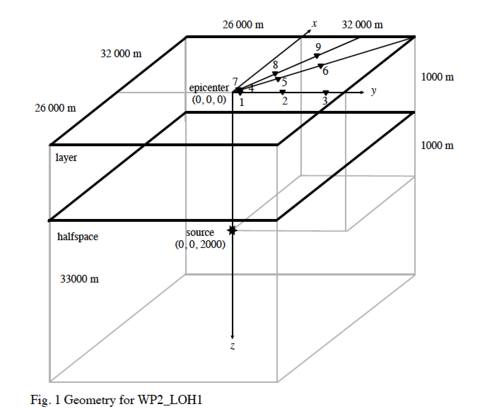
To verify the accuracy of this method we solve the layer over homogeneous halfspace (LOH.1) benchmark problem described by Day et al. This problem is a well-known reference benchmark for seismic wave propagation in numerical codes. The LOH.1 benchmark considers way propagation in a hexahedral geometry filled with two materials that are stacked on top of each other. The first material is characterised by a lower density and smaller seismic wave speeds.
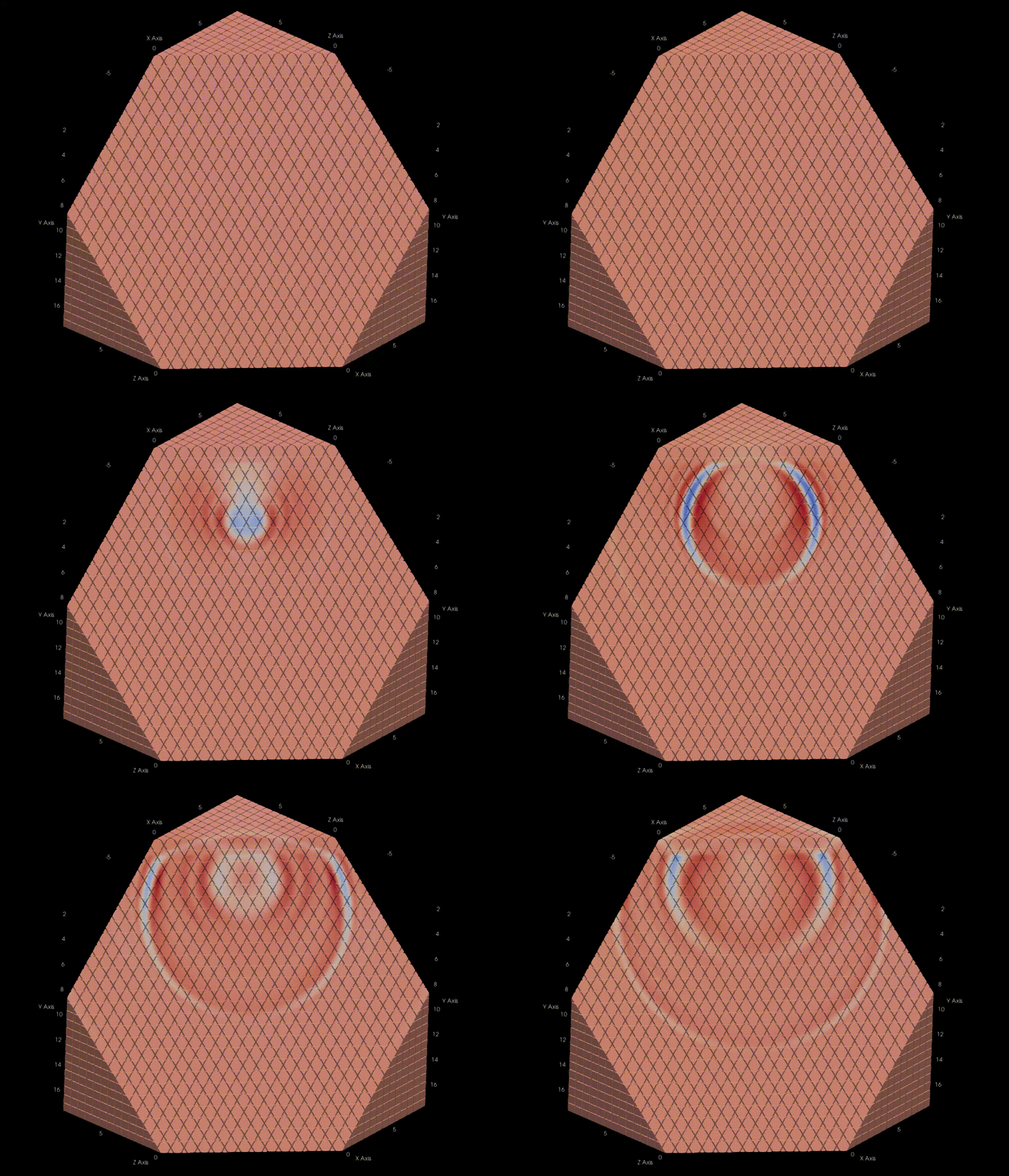
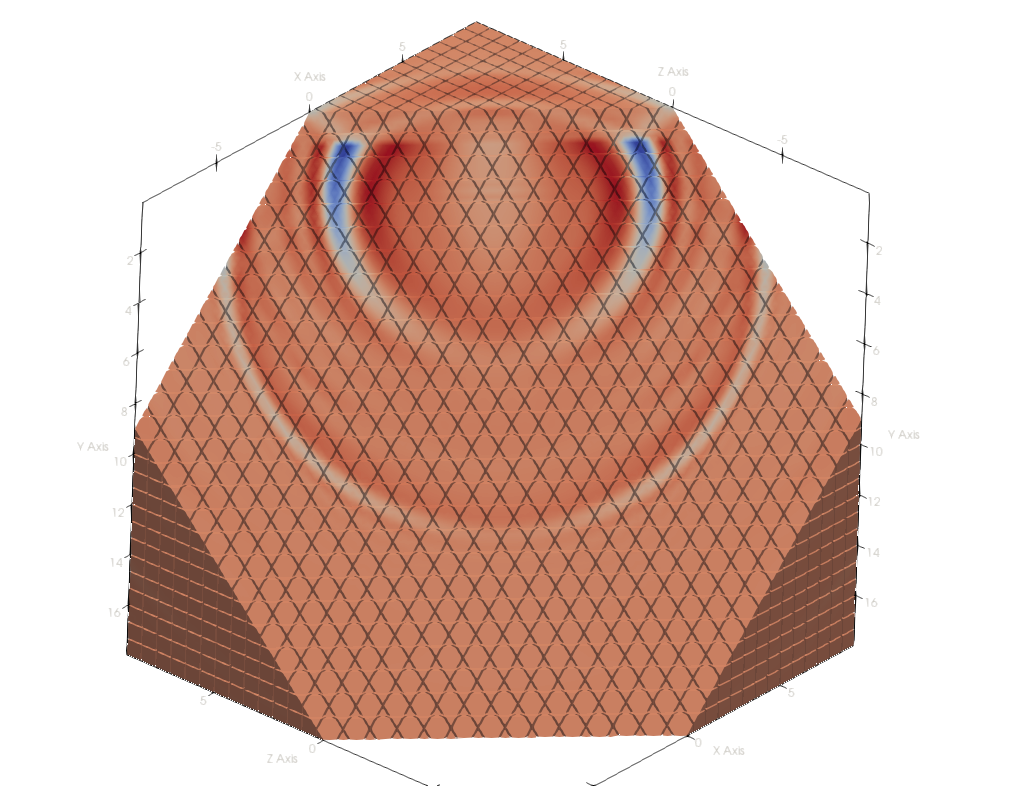
A point source is placed 2 km below the surface at the centre of the domain, such that the resulting wave propagates through the change of material.
 1.10.0